
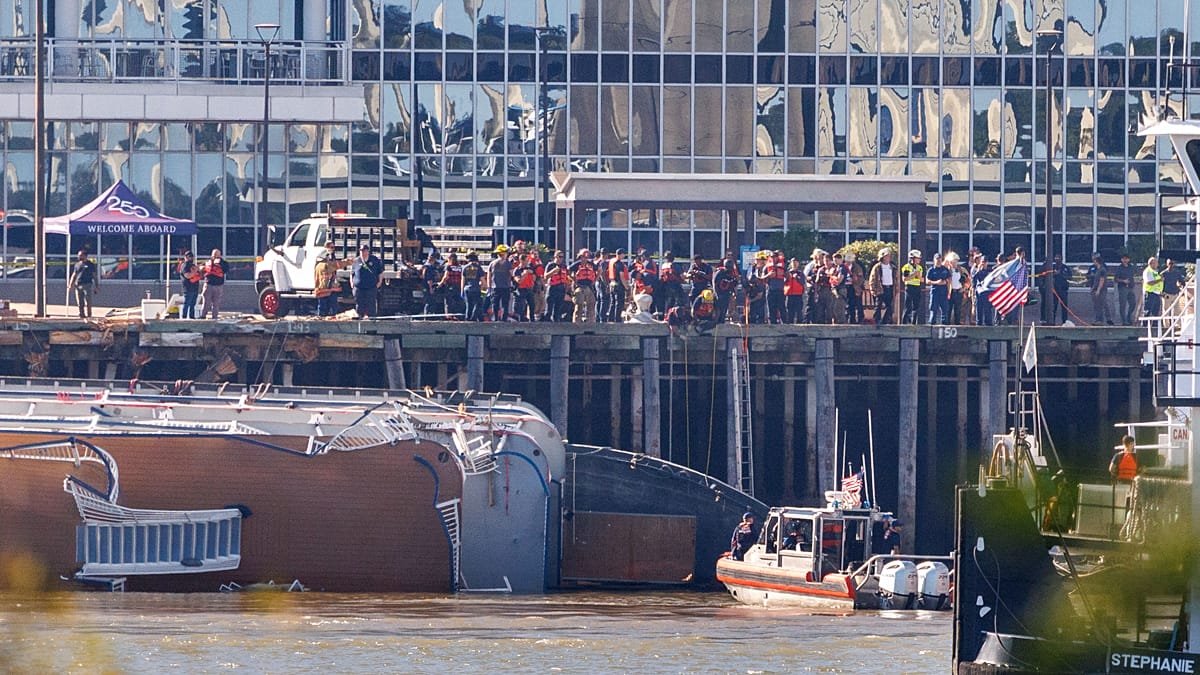
Technical Specifications and Architectural Breakdown
To understand the severity of the incident, one must examine the engineering limitations of the American Heritage. Unlike deep-sea vessels or modern ocean liners, river-touring ships are often built for shallow-draft navigation and aesthetic appeal rather than heavy-duty structural reinforcement. The American Heritage lacks the advanced collision-mitigation features required to withstand impact from a vessel possessing the significant displacement of a commercial tanker.
From a technical perspective, the ship’s design is optimized for maneuverability in tight river bends, prioritizing a lower center of gravity and specific hull geometry suited for inland currents. However, this design philosophy leaves the vessel’s lateral structure exposed. The ship lacks active electronic geofencing—a technology that would have alerted the crew to the tanker’s deviation from its lane—and automatic collision avoidance systems (ACAS). In modern commercial shipping, these systems utilize radar and AIS (Automatic Identification System) data to predict trajectories and issue warnings. The absence of these automated buffers meant the tanker’s approach was likely managed through manual observation alone, providing no redundant safety layer when human error or mechanical failure occurred on the tanker side.
Furthermore, the material composition of the American Heritage does not include the high-tensile energy-absorbing bow or side-plating found on newer, safety-focused naval or commercial designs. When the tanker made contact, the lack of structural compartmentalization meant that the hull integrity was compromised rapidly, leading to partial submersion. The vessel’s communication infrastructure also proved insufficient for the rapid-response demands of an emergency scenario, relying on standard consumer-grade protocols rather than the hardened, redundant digital communication arrays required for high-risk maritime zones.
Industry Landscape and Competitive Comparison
The incident highlights a widening gap between heritage-style river vessels and modern maritime safety requirements. As river tourism grows in popularity, the vessels operating in these spaces are often retrofitted or built with older design principles that do not account for the increasing size of commercial tankers sharing the same waterways. The following table compares the American Heritage against industry benchmarks for modern maritime safety.
| Feature | Modern Commercial Standard | American Heritage |
|---|---|---|
| Navigation Tech | AI-Assisted Radar/Lidar | Manual/Basic AIS |
| Collision Avoidance | Automated Geofencing/ACAS | None |
| Hull Impact Resistance | High-Tensile Reinforced Steel | Standard Touring Gauge |
| Emergency Communication | Encrypted Digital Redundancy | Standard Consumer Grade |
The comparison underscores a systemic issue: the industry is currently operating under a regulatory framework that treats river cruising as a leisure activity, while the physical environment—the river—is a high-traffic industrial corridor. While newer vessels entering the market are beginning to integrate advanced sensors, the existing fleet, including the American Heritage, remains constrained by legacy design choices that prioritize passenger comfort and deck space over structural survivability.
Practical Consumer & Enterprise Takeaways
For travelers, the incident serves as a sobering reminder that river cruising is not immune to the risks of commercial logistics. When selecting a vessel for river travel, consumers should look beyond the amenities and consider the ship’s safety certification and technological equipment. While it is difficult for a layperson to audit a ship’s structural integrity, prospective passengers should prioritize lines that disclose their investment in safety upgrades, such as enhanced radar suites and updated communication arrays.
From an enterprise standpoint, the collision serves as a call for mandatory technology retrofits. Operators of river vessels must acknowledge that manual navigation is insufficient in an era of massive tankers and unpredictable river traffic. The cost-benefit analysis of installing geofencing and collision-alert systems is no longer a matter of luxury; it is a fundamental requirement for risk mitigation. Insurance providers will likely demand these upgrades as a prerequisite for coverage in the coming years, potentially forcing a market-wide shift toward safer, tech-integrated vessel designs.
Frequently Asked Questions
Why did the American Heritage not detect the tanker’s approach?
The vessel relies primarily on manual observation and basic AIS monitoring. Without automated geofencing or predictive collision software, the ship’s crew lacked the early-warning capabilities necessary to identify the tanker’s deviation from its path in time to take evasive action or alert port authorities.
Is the American Heritage design inherently unsafe for river travel?
The design is functional for routine navigation, but it lacks the secondary safety systems required for high-risk environments. It is effectively a legacy design that has not been equipped with the modern electronic safeguards now standard in commercial maritime operations.
What does this incident mean for future river cruise regulations?
The incident will likely trigger a review by Port NOLA and federal maritime regulators regarding the proximity of docking terminals to commercial shipping lanes. Expect new mandates for vessels to carry active collision-avoidance technology and potential restrictions on tanker traffic during passenger-boarding windows.
The Bottom Line
The American Heritage incident is a definitive inflection point for the river cruise industry. The collision demonstrates that aesthetic appeal and traditional river-touring design can no longer be decoupled from the realities of modern industrial maritime traffic. While the ship functioned within its intended design parameters, those parameters are clearly insufficient for the current operating environment. Moving forward, the industry must prioritize the integration of AI-assisted navigation, automated collision avoidance, and reinforced hull standards. Until these technical gaps are closed, the responsibility lies with both operators and regulators to ensure that the safety of passengers is not treated as an afterthought in the design process.
 Arjun Mehta