
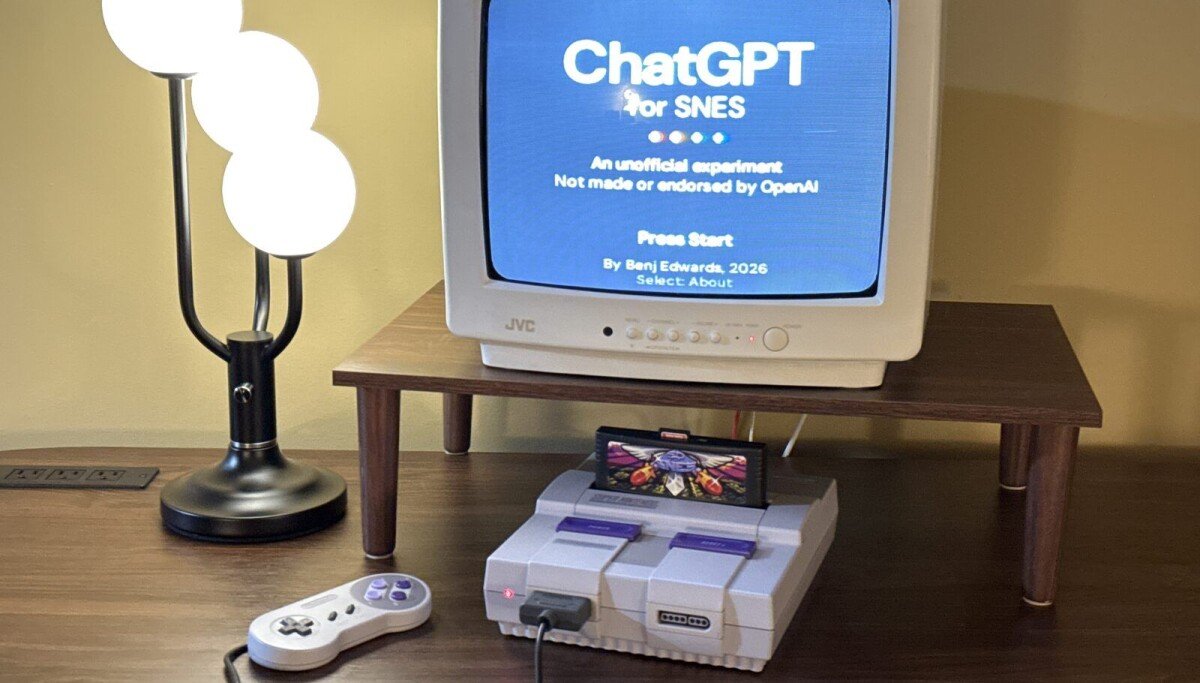
Technical Specifications and Architectural Breakdown
The engineering required to port a functional language model to the SNES is significant. At the heart of the system is a 2.2 million-parameter model derived from OpenAI’s GPT-OSS-120b architecture. To put this into perspective, modern enterprise models operate in the hundreds of billions of parameters. The reduction to 2.2 million is a feat of aggressive quantization and pruning, resulting in a model footprint that occupies between 4MB and 19MB—a size that fits within the memory mapping capabilities of a custom SNES cartridge.
The processing architecture is perhaps the most impressive element of the build. Because the SNES Ricoh 5A22 CPU lacks the instruction set to handle even basic matrix multiplication efficiently, the system offloads computation to the Super FX graphics coprocessor. While the Super FX was originally designed to render 3D polygons for titles like Star Fox, its RISC-based architecture is repurposed here to handle the floating-point math required for token prediction. The vocabulary is strictly capped at 8,000 words, which forces the model to prioritize high-frequency tokens, often resulting in surreal or nonsensical outputs. Data is served via a custom memory mapper that tricks the SNES into reading the model weights as if they were graphics data, bypassing the standard 128KB work RAM limitation.
Industry Landscape and Competitive Comparison
To understand the utility of this project, one must contrast it with the current industry standard. Modern AI is defined by high latency, cloud dependency, and massive power consumption. In contrast, this SNES implementation is entirely offline and self-contained. While it lacks the utility of a modern assistant, it serves as a proof-of-concept for edge-case computing where network access is non-existent.
| Feature | Enterprise LLM | Chatgpt For Snes | Local Desktop AI |
|---|---|---|---|
| Hardware | Data Center (H100 GPUs) | SNES + Super FX | Consumer GPU (RTX 4090) |
| Connectivity | Cloud-Dependent | Offline/Static | Offline/Local |
| Knowledge Base | Dynamic/Internet | Static/Compressed | Context-Specific |
| Primary Utility | Productivity/Analysis | Experimental/Retro | Privacy/Development |
The comparison highlights a clear divide: whereas Enterprise LLMs aim for broad, accurate information retrieval, the SNES implementation prioritizes the preservation of the model’s logical structure within a constrained environment. It is an exercise in minimalism that challenges the industry’s current trend of “bigger is better.”
Practical Consumer & Enterprise Takeaways
For the average consumer or enterprise user, the SNES implementation offers no immediate productivity benefits. It is not an upgrade path for office workflows, nor is it a viable tool for data analysis. However, it provides a valuable lesson in hardware efficiency. The project demonstrates that even with extremely limited computational resources, the core logic of a neural network can be preserved.
For developers, the takeaway is the viability of extreme model distillation. If a 2.2 million-parameter model can generate coherent, if limited, text on hardware from 1990, the potential for deploying lightweight AI on modern microcontrollers and IoT devices is substantial. Organizations looking to implement “dumb” but functional AI at the edge—such as in smart appliances or industrial sensors—can look to these retro-engineering efforts as a blueprint for optimizing their own local deployments.
Frequently Asked Questions
Is the output of the SNES model factually reliable?
No. Due to the extreme compression and the limited 8,000-word vocabulary, the model frequently hallucinates. It is designed for creative, experimental interaction rather than factual retrieval.
Can this be run on a standard SNES console without modifications?
While it technically runs on original hardware, it requires a custom-manufactured flash cartridge capable of handling the memory mapping and the extra processing power provided by the Super FX chip. A stock, unmodified console will not be able to load or process the model weights.
What is the primary barrier to improving the model’s intelligence?
The bottleneck is the SNES memory architecture and CPU speed. Even with the Super FX coprocessor, the system is starved for bandwidth. Increasing the parameter count would exceed the console’s ability to fetch and process tokens in a timeframe that would be considered remotely responsive.
The Bottom Line
The project serves as a compelling intersection of historical hardware and future-facing software. It is a technical curiosity that exposes the fragility and the resilience of neural networks when stripped of their massive computational support systems. While it lacks the functional utility required for professional environments, it succeeds as an engineering milestone. It reminds us that the fundamental principles of machine learning—tokenization, weighting, and inference—are not tethered to the data centers of today. As we continue to scale AI upward, projects like this provide a necessary counter-balance, reminding us of the efficiency that can be achieved through rigorous optimization and creative architectural design.
 Maya Deshmukh
[…] 8.6 Tackles Critical Flaws with New Defaults ChatGPT for SNES Pushes Boundaries of Legacy Tech EU Outpaces loopholes with new Russian sanctions Hakeem Jeffries Targets Speaker Seat in […]
[…] Mastercard breach reveals limited data exposure ChatGPT for SNES Pushes Boundaries of Legacy Tech PHP 8.6 Tackles Critical Flaws with New Defaults EU Outpaces loopholes with new Russian […]
[…] replace apps to streamline daily workflows Visa Mastercard breach reveals limited data exposure ChatGPT for SNES Pushes Boundaries of Legacy Tech PHP 8.6 Tackles Critical Flaws with New Defaults EU Outpaces loopholes with new Russian […]
[…] replace apps to streamline daily workflows Visa Mastercard breach reveals limited data exposure ChatGPT for SNES Pushes Boundaries of Legacy Tech PHP 8.6 Tackles Critical Flaws with New […]
[…] Corporate Security Experts Flag AI honey-trap Dangers Apple Sued in India Over Tap-to-Share Contacts Tool AI agents replace apps to streamline daily workflows Visa Mastercard breach reveals limited data exposure ChatGPT for SNES Pushes Boundaries of Legacy Tech […]
[…] Recommended ReadingChatGPT for SNES Pushes Boundaries of Legacy Tech → […]
[…] Recommended ReadingChatGPT for SNES Pushes Boundaries of Legacy Tech → […]
[…] Recommended ReadingChatGPT for SNES Pushes Boundaries of Legacy Tech → […]
[…] Recommended ReadingChatGPT for SNES Pushes Boundaries of Legacy Tech → […]
[…] Recommended ReadingChatGPT for SNES Pushes Boundaries of Legacy Tech → […]
[…] Recommended ReadingChatGPT for SNES Pushes Boundaries of Legacy Tech → […]
[…] Recommended ReadingChatGPT for SNES Pushes Boundaries of Legacy Tech → […]
[…] Recommended ReadingChatGPT for SNES Pushes Boundaries of Legacy Tech → […]
[…] Recommended ReadingChatGPT for SNES Pushes Boundaries of Legacy Tech → […]
[…] Recommended ReadingChatGPT for SNES Pushes Boundaries of Legacy Tech → […]
[…] Recommended ReadingChatGPT for SNES Pushes Boundaries of Legacy Tech → […]
[…] Recommended ReadingChatGPT for SNES Pushes Boundaries of Legacy Tech → […]
[…] Recommended ReadingChatGPT for SNES Pushes Boundaries of Legacy Tech → […]
[…] Recommended ReadingChatGPT for SNES Pushes Boundaries of Legacy Tech → […]
[…] Recommended ReadingChatGPT for SNES Pushes Boundaries of Legacy Tech → […]
[…] Recommended ReadingChatGPT for SNES Pushes Boundaries of Legacy Tech → […]
[…] Recommended ReadingChatGPT for SNES Pushes Boundaries of Legacy Tech → […]
[…] Recommended ReadingChatGPT for SNES Pushes Boundaries of Legacy Tech → […]
[…] Recommended ReadingChatGPT for SNES Pushes Boundaries of Legacy Tech → […]
[…] Recommended ReadingChatGPT for SNES Pushes Boundaries of Legacy Tech → […]
[…] Recommended ReadingChatGPT for SNES Pushes Boundaries of Legacy Tech → […]
[…] Recommended ReadingChatGPT for SNES Pushes Boundaries of Legacy Tech → […]
[…] Recommended ReadingChatGPT for SNES Pushes Boundaries of Legacy Tech → […]
[…] Recommended ReadingChatGPT for SNES Pushes Boundaries of Legacy Tech → […]